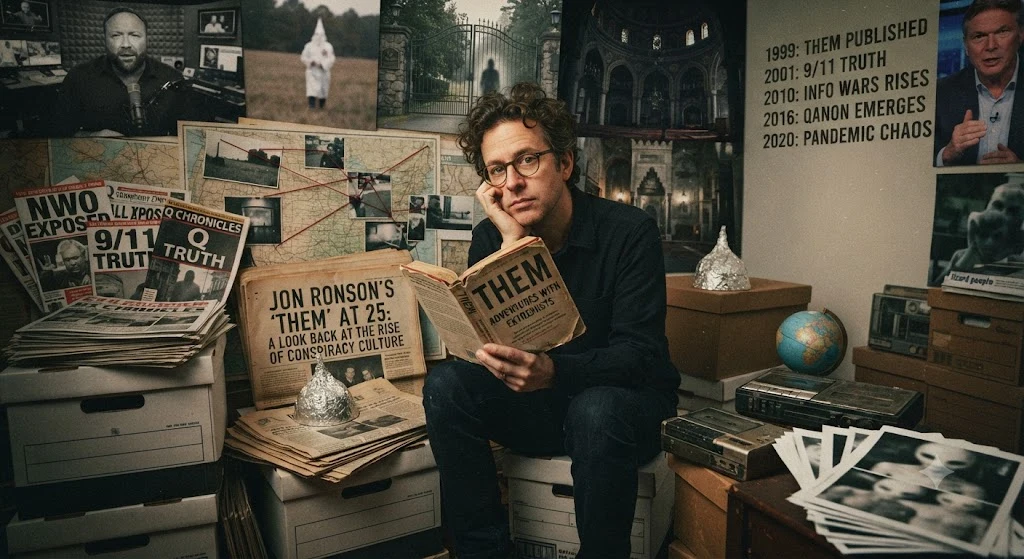
Jon Ronson’s 2001 book, Them: Adventures with Extremists, is marking its 25th anniversary. Written in the years leading up to the September 11 attacks, the work serves as a historical record of the fringe movements and anti-government sentiments that were bubbling in the Western world at the turn of the millennium.
Ronson’s initial goal was to profile individuals labeled as “extremist monsters,” ranging from neo-Nazis and militia members to Islamic fundamentalist Omar Bakri. However, the project evolved when Ronson discovered a common thread among these disparate groups: a shared belief in the “New World Order,” a conspiracy theory positing that a secret, elite cabal controls global events, markets, and governments from behind the scenes.
The book is notable for introducing a wider audience to Alex Jones, then a regional radio host in Texas. Ronson and Jones famously infiltrated the Bohemian Grove in Northern California, where they witnessed wealthy and politically connected men participating in an effigy-burning ritual. While Ronson interpreted the event as elite “play-acting,” Jones viewed it as evidence of a sinister occult agenda. Ronson has since expressed regret for the role his work played in elevating Jones, whom he now describes as “the most irresponsible man I have ever met.”
Them also explores the roots of modern anti-government paranoia through the lens of the 1992 Ruby Ridge standoff, a tragedy that became a rallying point for American militia movements. Ronson’s investigative style, characterized by a refusal to rely on easy caricatures, sought to present his subjects as complex individuals rather than simple villains. Over the last two decades, Ronson has continued this focus on the unusual and the fringe through works such as The Men Who Stared at Goats and his podcast Things Fell Apart.
Reflecting on the book’s legacy, the narrative suggests that what once appeared to be marginal, conspiratorial thinking has become increasingly routine in the modern era. While real-world scandals involving figures like Jeffrey Epstein have demonstrated that the wealthy can indeed hide serious crimes, these events are often absorbed into broader, more extreme conspiracy narratives, further blurring the lines between fact and fiction.
Source: The Conversation
No comments yet. Be the first to share your thoughts.