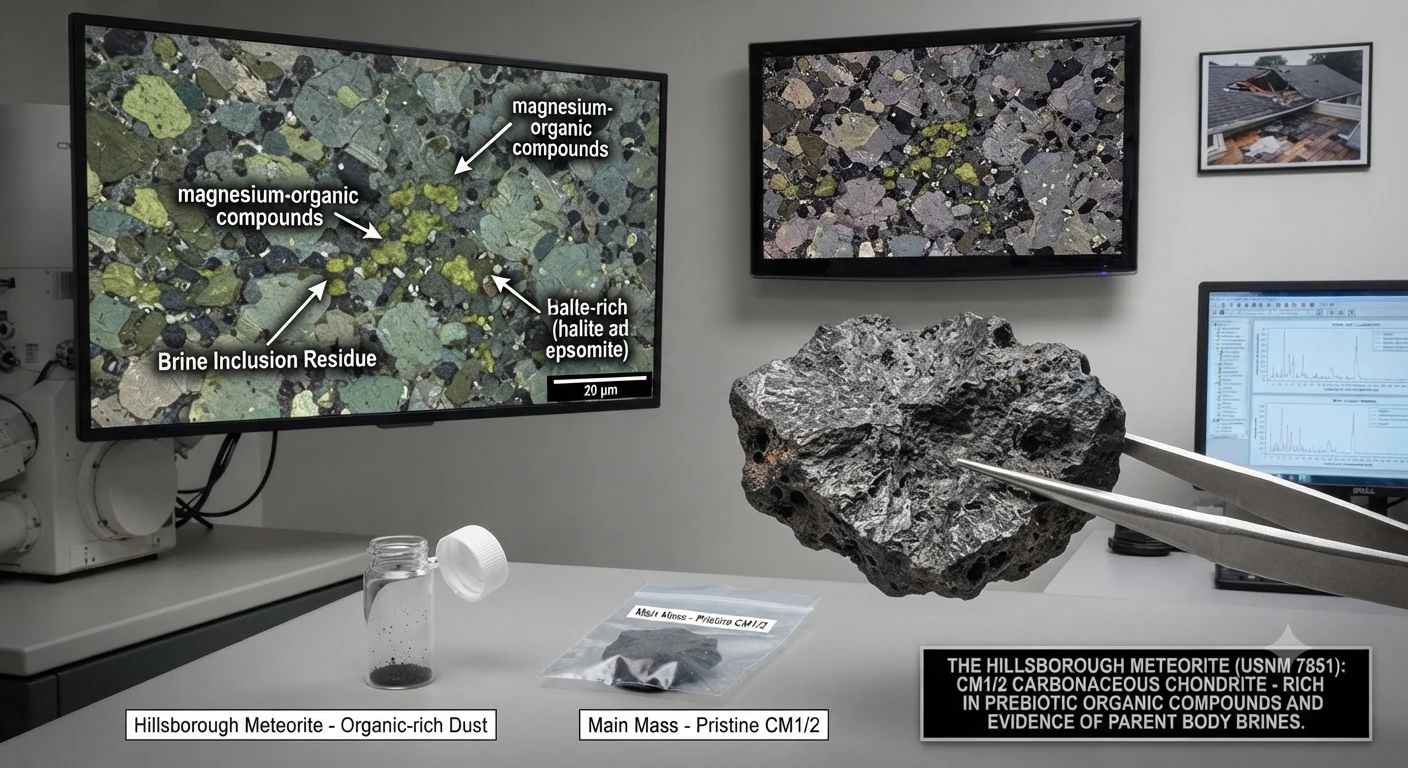
A meteorite that crashed through the roof of a Hillsborough, New Jersey, residence on July 16, 2024, has provided scientists with a rare opportunity to study primitive space materials. The object, which weighed approximately three pounds, entered the atmosphere as a fireball before fragmenting and striking a bedroom ceiling.
Following the impact, the homeowners preserved the debris using gloves and glass containers, guided by the American Meteor Society. This rapid collection allowed researchers to analyze the samples in a highly pristine state. According to a study published in Science Advances, the rock is classified as a CM carbonaceous chondrite, specifically an intermediate CM1/2 type—a rare category of which only two known examples have been recovered.
Laboratory analysis revealed that the meteorite contains amino acids and other organic compounds. Furthermore, the presence of sodium-rich material within microscopic fractures suggests that the parent asteroid once hosted flowing salty water. NASA astrobiologist Danny Glavin noted that the complexity of the organic compounds found in the sample was a significant discovery.
By tracking the fireball's trajectory, researchers traced the meteorite's origins to the 45-mile-wide asteroid 163 Erigone, located in the inner asteroid belt. Scientists believe the fragment was liberated during a collision approximately six million years ago and eventually entered Earth's atmosphere at a speed of 32,000 miles per hour.
Source: Smithsonian Magazine
No comments yet. Be the first to share your thoughts.