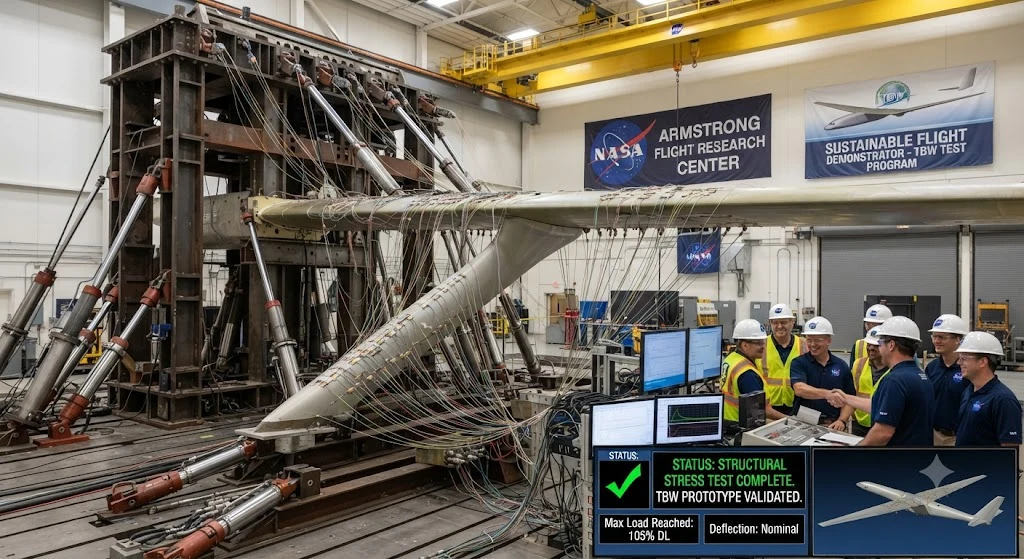
NASA researchers have concluded a series of rigorous structural evaluations on the Structural Wing Experiment Evaluating Truss-bracing (SWEET-15), a 15-foot test article designed to advance the development of ultra-efficient commercial aircraft. The project, which utilizes a long, thin wing supported by an aerodynamic strut, aims to improve fuel efficiency through lightweight composite construction.
The test article was developed at NASA’s Langley Research Center in Virginia, where it was fabricated using five distinct advanced composite manufacturing technologies, including the Integrated Structural Assembly of Advanced Composites robot. The wing was subsequently transported to the Armstrong Flight Research Center in California for mechanical stress testing in the Flight Loads Laboratory.
During the multi-month evaluation, engineers utilized fiber-optic strain sensors and other load-tracking equipment to monitor the wing's response to increasing forces. The data collected confirmed that the structure performed as predicted by computer models, successfully handling anticipated in-flight loads. The testing concluded with a deliberate failure analysis, where the wing was subjected to forces reaching 127% of its design limit. The resulting data provided critical insights into the behavior of the wing's joints and structural integrity beyond standard flight parameters.
This initiative represents the first time a composite truss-braced wing configuration has undergone such comprehensive structural testing. The project is part of NASA’s Subsonic Flight Demonstrator effort, aimed at refining manufacturing methods for lighter, stronger aerospace components. Researchers are now analyzing the gathered data to guide the design of future airframes.
Source: NASA
No comments yet. Be the first to share your thoughts.