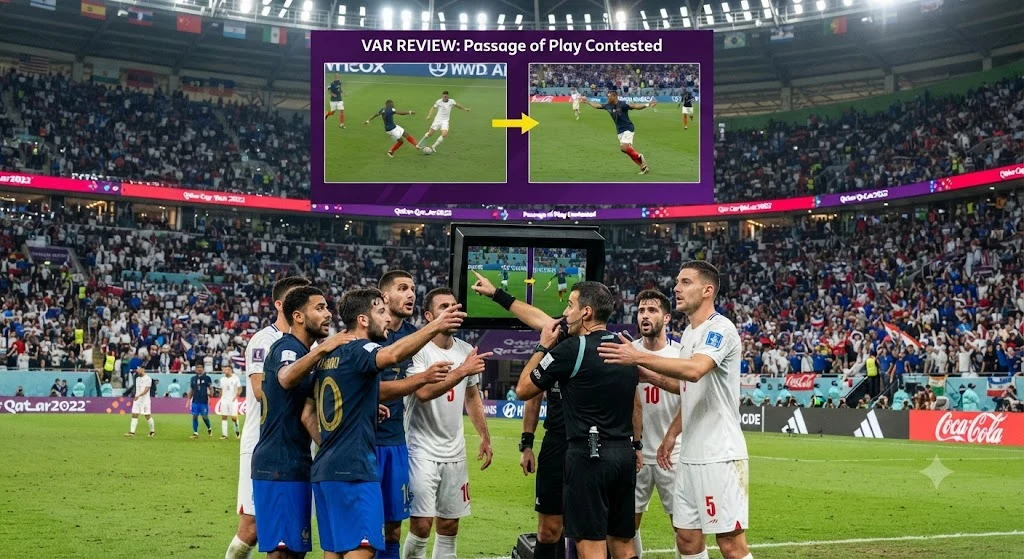
High-profile officiating decisions during the 2026 World Cup have intensified scrutiny regarding the application of Video Assistant Referee (VAR) technology. While VAR is designed to rectify “clear and obvious errors,” the system relies heavily on human judgment to define the scope and context of a reviewable passage of play, a process that remains inherently subjective.
Two specific matches illustrate these complexities. During a round of 16 game between Argentina and Egypt, an Egyptian goal was disallowed after a review identified a foul that occurred 17 seconds earlier and 80 meters away from the scoring site. Former officials remain divided on the decision; while some argue the play remained continuous, others contend the time and distance elapsed should have severed the link between the foul and the goal. In a separate quarterfinal match, a goal by Norway’s Torbjørn Heggem was overturned because Erling Haaland pushed an opponent before the ball was technically in play. Officials determined the push had a direct causal link to the subsequent goal, despite questions regarding whether the review should have accounted for earlier physical interactions between the two players.
Researchers studying the ethics of AI in sports note that while VAR improves accuracy—with studies showing success rates rising from 92.1% to 98.3% following interventions—it does not provide the context necessary for interpretation. The selection of replay angles, speed, and duration effectively creates a “visual narrative” that can influence a referee’s perception of an event.
To improve the fairness and transparency of the process, experts suggest that referees should prioritize normal-speed footage for judging intensity, using slow motion only to confirm contact. Furthermore, they advocate for post-match public explanations from FIFA regarding the rationale behind consequential reviews, including the specific timing and distance parameters used to define the incident. Ultimately, the authors argue that technology must remain a support tool for human officials, who alone possess the capacity to weigh the broader context of a match.
Source: The Conversation
No comments yet. Be the first to share your thoughts.